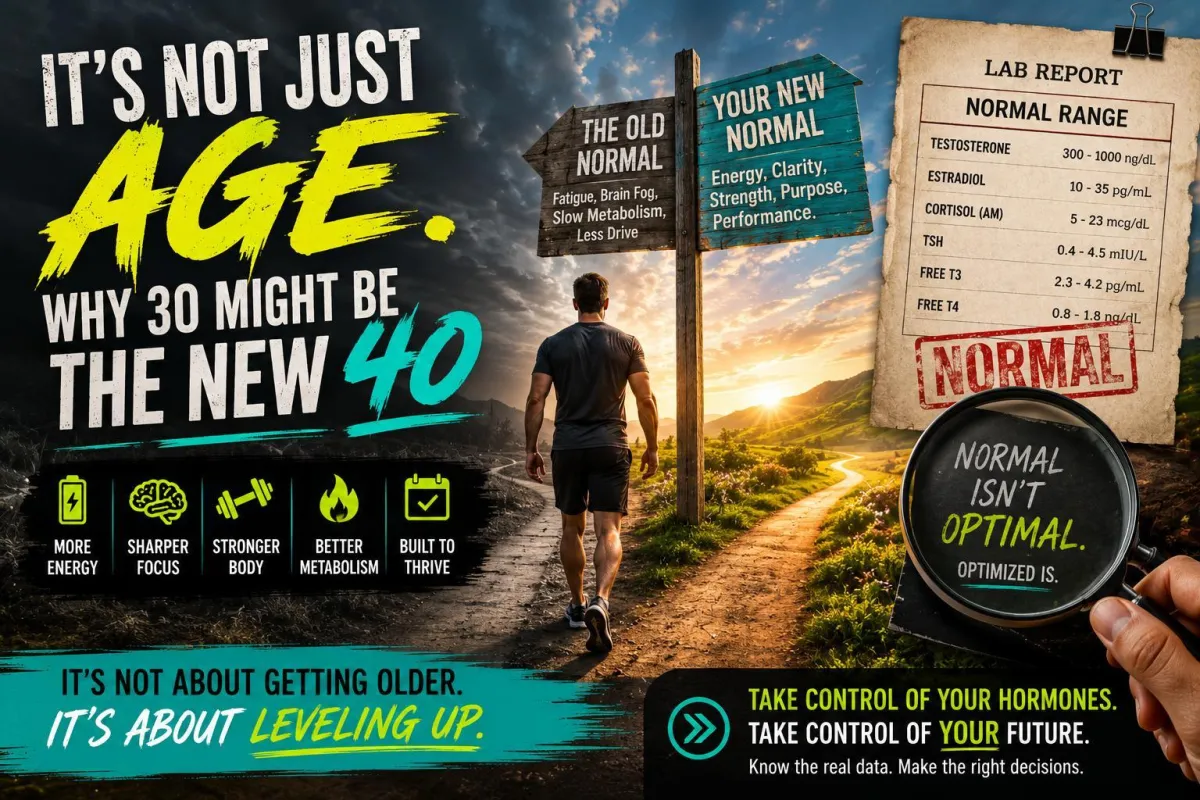
It's Not Just Age: Why 30 Might Be the New 40
The way you feel is not just “getting older,” and it is not waiting for a birthday. “Normal labs” do not always mean you are optimized, at 40, at 30, or wherever you're starting to notice it.
Personalized Hormone Optimization · optimizemd.health
A Note From Dr. Mike
Somewhere around 40, most people notice a shift. It is not one big event. It is a hundred small ones. You sleep the same hours but wake up less rested. Your body holds onto weight it used to shed easily. Your patience runs thinner. Your drive is quieter.
Then you get labs and hear the same thing: “Everything looks normal.”
But normal does not always mean optimized.
What used to show up in your 40s is showing up earlier for a lot of people now, and it is rarely just about age. The pages ahead walk through what to actually watch for, and why.
WHAT'S INSIDE THIS GUIDE
01
Why 30 Might Be the New 40
02
The First Signs to Watch For
03
The Signs Most People Miss
04
What to Actually Do About It
Why 30 Might Be the New 40
Your 40s are when testosterone, estrogen, progesterone, thyroid, and cortisol all begin to shift, for men and women both, often years before a lab value crosses into “abnormal.” But it is worth being clear about why 40 is the number people notice: it is not a biological switch that flips. It is when years of cumulative exposure to endocrine-disrupting chemicals, compounds in plastics, personal care products, and food packaging that the Endocrine Society's own scientific statements confirm interfere directly with hormone signaling, finally catches up to what a lab test can detect.
Some hormonal change with age is genuinely normal biology. The scale and the early onset of what we are seeing now is not fully explained by aging alone, and the research bears that out plainly: the average age of menarche, a hard hormonal milestone, has dropped from 16 to 17 years a century ago to under 13 today, a shift researchers have found cannot be explained by nutrition alone. Dysfunction is not waiting for 40 anymore. It is showing up younger every year.
At OptimizeMD, we look deeper. Hormones are connected to energy, mood, metabolism, sleep, memory, and how fully you feel like yourself.
This guide is not a diagnosis or treatment protocol. It is designed to help you recognize the signs your body may be asking for a deeper hormone evaluation.
THE PATTERN RESEARCHERS KEEP FINDING
Average age of menarche, a century ago
16 to 17 years
Average age of menarche, today
Under 13 years
Explained by nutrition alone
No, per the research
Endocrine Society position on EDCs and hormone systems
Direct interference confirmed
None of this means every symptom has an environmental cause, or that aging stops mattering. It means the calendar is a worse predictor than it used to be, and the signs on the following pages are worth taking seriously whether you are 28, 38, or 48.
The First Signs
Signs 1 Through 5
1. Your Energy Crashes By Afternoon
You sleep the same number of hours you always have, but you do not wake up feeling like it counted. By early afternoon, you are running on fumes, reaching for coffee or sugar just to get through the rest of the day.
This is not a willpower problem. It is often a hormone problem.
2. Your Weight Has Shifted, Even Though Nothing Else Changed
Weight that used to come off easily now holds on, especially around the midsection. This happens on the same diet and the same workouts that used to work just fine.
Metabolism is hormonally driven, not just a math problem of calories in and out.
3. Your Sleep Isn't What It Used To Be
You fall asleep fine, or maybe you do not, but either way you wake up in the middle of the night, or you wake up tired no matter how early you went to bed. Sleep stops feeling restorative.
Hormones regulate sleep quality, not just how many hours you log.
4. Your Mood Swings More, Or Your Patience Runs Shorter
Small things set you off more than they used to. Or the opposite happens, and you feel flat, less interested in things that used to bring you joy.
Mood is not only psychological. Mood is biological too.
5. Your Drive Has Quieted
Motivation at work, interest in intimacy, enthusiasm for things you used to look forward to, all of it can fade the same way, quietly and gradually, until you notice it has been gone for a while.
Drive is not just mindset. It has a hormonal foundation.
The Final Signs
Signs 6 Through 10
6. Your Memory And Focus Aren't As Sharp
You walk into a room and forget why. You lose the thread of a conversation. Words you know well suddenly take a second longer to find. It is easy to write this off as being busy, but it can happen even when life has not gotten more demanding.
The brain is a hormonally sensitive organ, not an exception to how the rest of the body works.
7. Your Body Takes Longer To Recover
Workouts leave you sore for days instead of one. Stress hits harder and lingers longer. A minor cold used to pass in a couple of days, now it seems to camp out for a week.
Recovery is not just willpower. It is biology.
8. Your Skin, Hair, Or Joints Feel Different
Skin that used to bounce back feels drier or thinner. Hair sheds more than it used to. Joints ache in ways that do not seem to match how active, or inactive, you actually are.
These are often hormone stories, not just aging stories.
9. You Feel Hot Or Cold At Times That Don't Make Sense
Sudden warmth for no reason. Hands and feet that stay cold when everyone else is comfortable. Temperature regulation is one of the quieter signs people rarely connect back to their hormones.
This is your body's thermostat telling you something has shifted.
10. You Just Don't Feel Like The Same Version Of Yourself
This may be the most important sign of all. You may be doing everything “right,” and still feel like a dimmer version of who you used to be. Something in you knows this is not simply what aging is supposed to feel like.
Symptoms are signals. The body is speaking.
The OptimizeMD Perspective
Most clinics stop at numbers. Most wellness advice tells you to sleep more, eat better, exercise, and manage stress. Those things matter, but if you still do not feel like yourself, you may need a deeper evaluation.
At OptimizeMD, hormone optimization is personalized, physician guided, and connected to the whole person, for men and women both. Hormones are part of a larger conversation involving energy, mood, metabolism, cognition, recovery, nervous system function, and vitality.
We do not give cookie cutter protocols. We do not chase numbers. We look at the person. The goal is not just better labs. The goal is helping you feel like yourself again.
Ready to Find Out What Your Body Is Telling You?
If your energy is fading, your sleep isn't restorative, your drive has quieted, and your focus feels blurred, it may be time to stop accepting “normal” as good enough.
This guide is not medical advice, a diagnosis, a treatment plan, or a replacement for proper labs, medical evaluation, or physician guidance. Hormone therapy is powerful and should be approached carefully, with appropriate testing, monitoring, and personalization.
START YOUR EVALUATION TODAY
Personalized Hormone Optimization, Physician Guided
OptimizeMD helps men and women restore their biological foundation through personalized, physician-guided hormone optimization. Find out what your body is telling you.
optimizemd.health · (702) 763-6233 · [email protected]
Educational disclaimer: This content is for general education only and does not establish a physician patient relationship. Individual symptoms may have many causes. Always consult a qualified medical professional before starting, stopping, or changing any medication or hormone therapy.
Sources: Gore AC, Chappell VA, Fenton SE, et al. “EDC-2: The Endocrine Society's Second Scientific Statement on Endocrine-Disrupting Chemicals.” Endocr Rev. 2015;36:593–602. Buttke DE, et al. “Exposure to Endocrine-Disrupting Chemicals and Age of Menarche in Adolescent Girls in NHANES.” Environ Health Perspect. 2012;120:1613–1618.
